Risk analysis in RiskPlus: systematically identifying and assessing risks
A thorough hazard analysis is at the heart of any risk management system in accordance with DVGW W 1001. In RiskPlus, water supply companies systematically identify which areas and land uses pose a potential risk to raw water – and how significant that risk is. The process is fully integrated throughout: from the automatic input database right through to its direct impact on the investigation programme.
Start automatically – without any manual preparation
The risk analysis follows on directly from the catchment area survey. Using the land-use data already stored in the ATKIS Basic DLM, RiskPlus automatically generates a structured list of existing land-use sectors and categories – known as hazard drivers. This eliminates the need for manual data entry, saving a great deal of time. If required, your own areas can be added at any time via a Shapefile or Excel file.
Assigning and categorising hazardous incidents
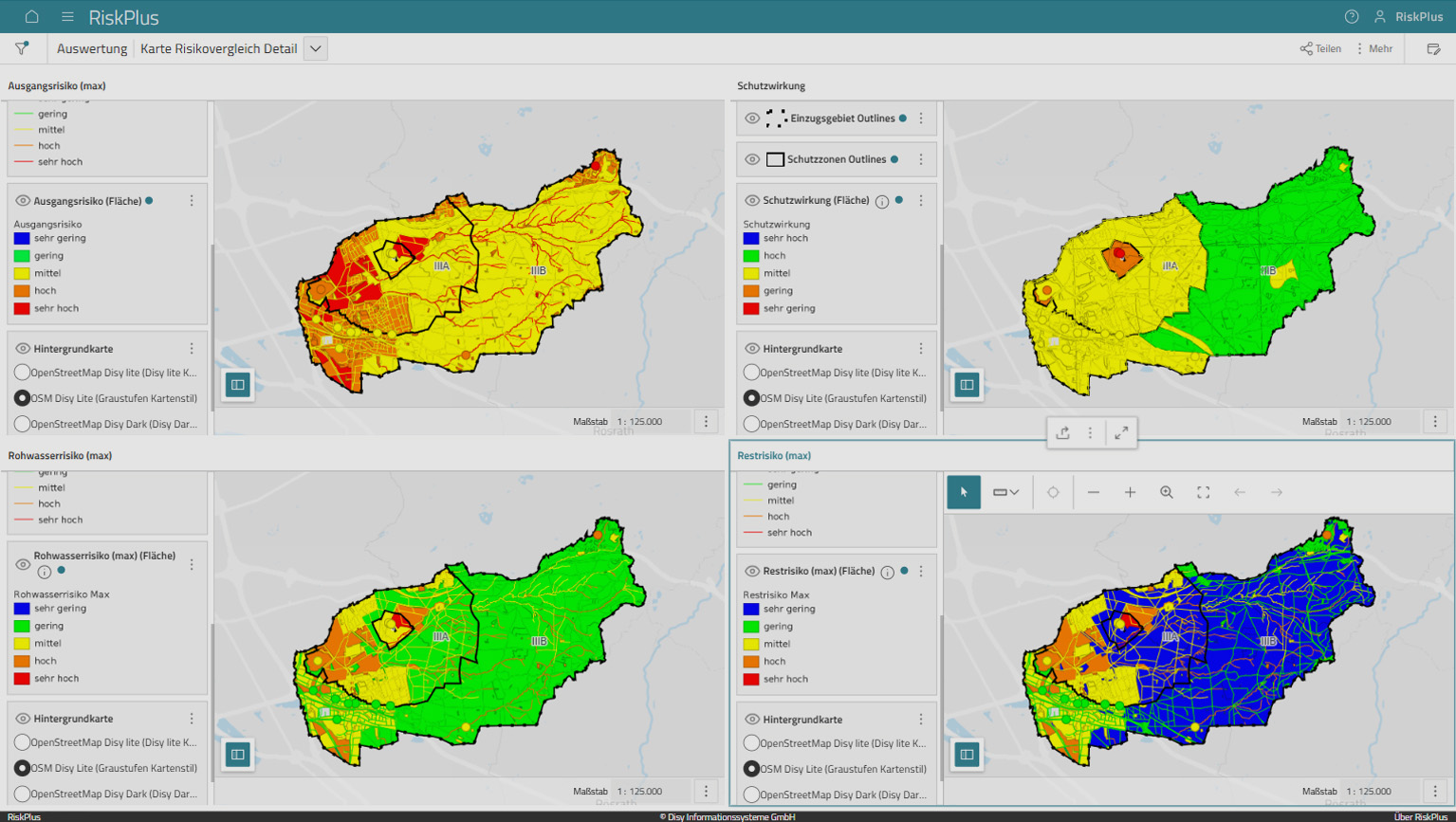
For each hazard source, RiskPlus suggests appropriate hazard events – including probability of occurrence, extent of damage and entry pathway. The specialist team can adopt these, adapt them or supplement them with their own events. The entry pathway is crucial to the assessment: depending on whether a pollutant acts above ground, below ground or as a direct input into surface water, the natural protective effect of the catchment area is factored into the risk assessment to varying degrees. All parameters can be adjusted on a site-by-site basis or via bulk editing. This ensures that the individual situation is taken into account.
Efficiency through catalogues and evaluation templates
Users of RiskPlus benefit from one key advantage: once risk events and measures have been defined, they can be applied as templates to other areas – without the need to re-enter the data. The underlying catalogue is fully manageable; entries can be duplicated, adapted or created from scratch. The dashboard, divided into risk assessment and risk control, shows at a glance at any time how far the processing has progressed.
The basis for the entire monitoring process
The hazard analysis is not an isolated step – everything that is recorded and assessed here has a direct impact on the testing programme. The identified raw water risk, together with the classification of measured values and the calculated trend, is incorporated into the recommendation as to which parameters should be sampled, where and at what intervals. In this way, the hazard analysis provides the substantive basis for systematic risk management in accordance with DVGW W 1001.

 Deutsch
  English (UK)
 Français